
The People Pyramid
Why Nick is gonna be so good at being rich
I sometimes joke with Nick (my co-founder) that he is going to make a great rich guy someday.
That’s a compliment I swear!
Nick is one of the least materialistic people I know. He doesn’t need things.
But the moment he can spend money to not deal with something himself — a task, an errand, a problem that would eat an hour of his day — he does it without hesitation.
Nick understands that his most valuable resource is time. We both are keenly aware that we’re all just a couple years from dying.
So, he doesn’t stuff, he buys his time back.
Classical economics divides economies into goods versus services. But I’d like to introduce just a little bit more nuance — what I have started thinking of as The People Pyramid.
At the bottom: commodities. Raw materials, bulk inputs, fungible things priced purely on volume. A barrel of oil. A bushel of wheat. Something that you can basically pull out of the Earth, and no matter where that’s done, it’s mostly the same.
Then come widgets: manufactured goods, the things you hold in your hand. Widgets generally take some commodities and process and assemble them in novel ways.
Then services: the transaction where someone does something for you.
And at the top, relationships: the ongoing, personalized, human connection that makes a service feel like something more.
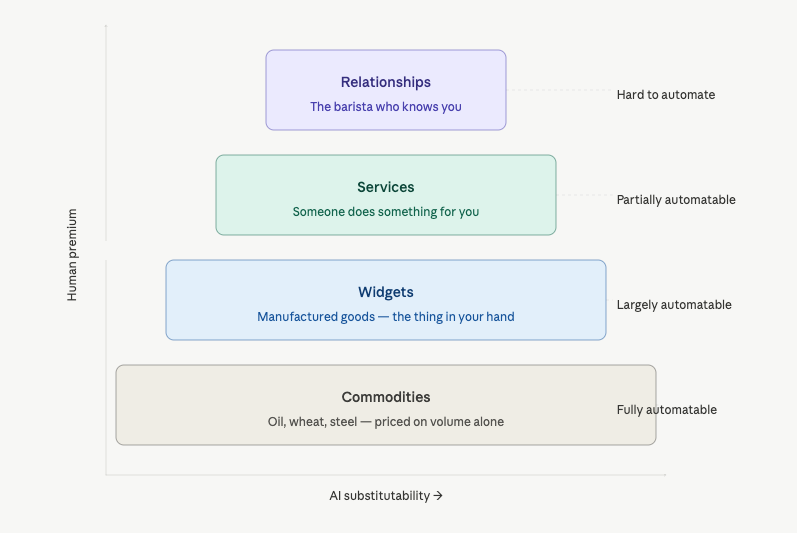
The People Pyramid traces two themes simultaneously.
First, this is how economies progress through time.
The agricultural revolution let us grow commodities and harvest them deliberately. Then the industrial revolution enabled us to turn those commodities into widgets efficiently. Then we advanced to services economies with the advent of software and automation. I think we are now on the brink of a relational economy.
But second, The People Pyramid reflects how people tend to act as they get wealthier.
Lower-income households spend a disproportionate share on necessities, things. Higher-income households spend increasingly on services.
Those wealthy enough will then go beyond services: concierge medicine, personal trainers who know your history, financial advisors who know your family, the hotel front desk person who already has your room key out when you walk in.
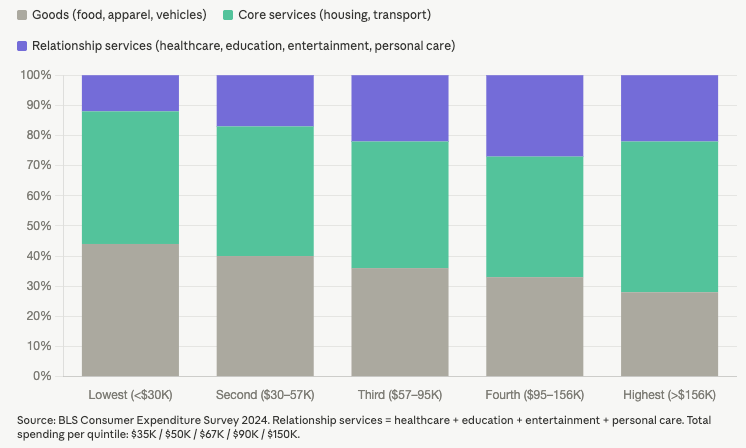
Research confirms what most of us intuitively sense: the happiness returns from buying experiences — which sit above pure goods on the spectrum — are actually absent at the lowest end of the income distribution. The Spectrum isn’t just a preference. It’s a luxury.
I can almost hear my readers at this point: yada yada Griff - give us the AI you freak!
Fine. Twist my arm. I’ll talk about AI.
We’ve spent a lot of energy debating which jobs AI will eliminate, but fundamentally, GDP is a function of spending and so a more interesting question might be: if we have so much automated, what do we spend on?
AI is extraordinarily good at the transactional middle of the Relationship Spectrum. It can handle the task. It can execute the service. What it cannot do is smile at me. Or make eye contact. Or shake my hand.
If AI compresses the cost and friction of pure services then the same logic that pushed advanced economies from manufacturing into services should push us from services into relationships. Up the Pyramid we go.
The thing I know Nick would pay an arm and a leg for isn’t a faster transaction. It’s someone that remembers something important and just does it for him, without him having to think about it. That’s a relationship. And if AI handles everything below it, the relationship becomes the only thing left worth paying a premium for.
The best services already blur the line between service and relationship. The barista who starts making your order when they see you walk in. The barber who asks about your daughter’s soccer tournament. These aren’t just good service. They’re the beginning of something that feels more like a relationship — and that’s exactly why you pay a premium for them, and why you’d never switch.
The ultra-wealthy have simply institutionalized this. They don’t have a financial advisor — they have a family office. They don’t book their own travel — they have someone whose job it is to know their preferences before they’re asked. What money buys, above a certain level, is the feeling of being taken care of. The relationship itself is the product.
Of course, I could be wrong. AI could just wipe all the jobs out in one fell swoop.
But as a possible counterweight to the job apocalypse thesis, it’s worth sitting with.
If we manage the transition well — a big if — AI doesn’t necessarily destroy work. It may just push the most valuable work further up the Pyramid.
Nick will get there. The rest of us are climbing.
Originally published on Griff’s Substack on 15 May 2026.